कूटनीति और अंतर्राष्ट्रीय संबंध: विदेश मंत्री जयशंकर ने UN सुधार के लिए 'पाठ-आधारित वार्ता' का किया आह्वान
26 Sep 2026
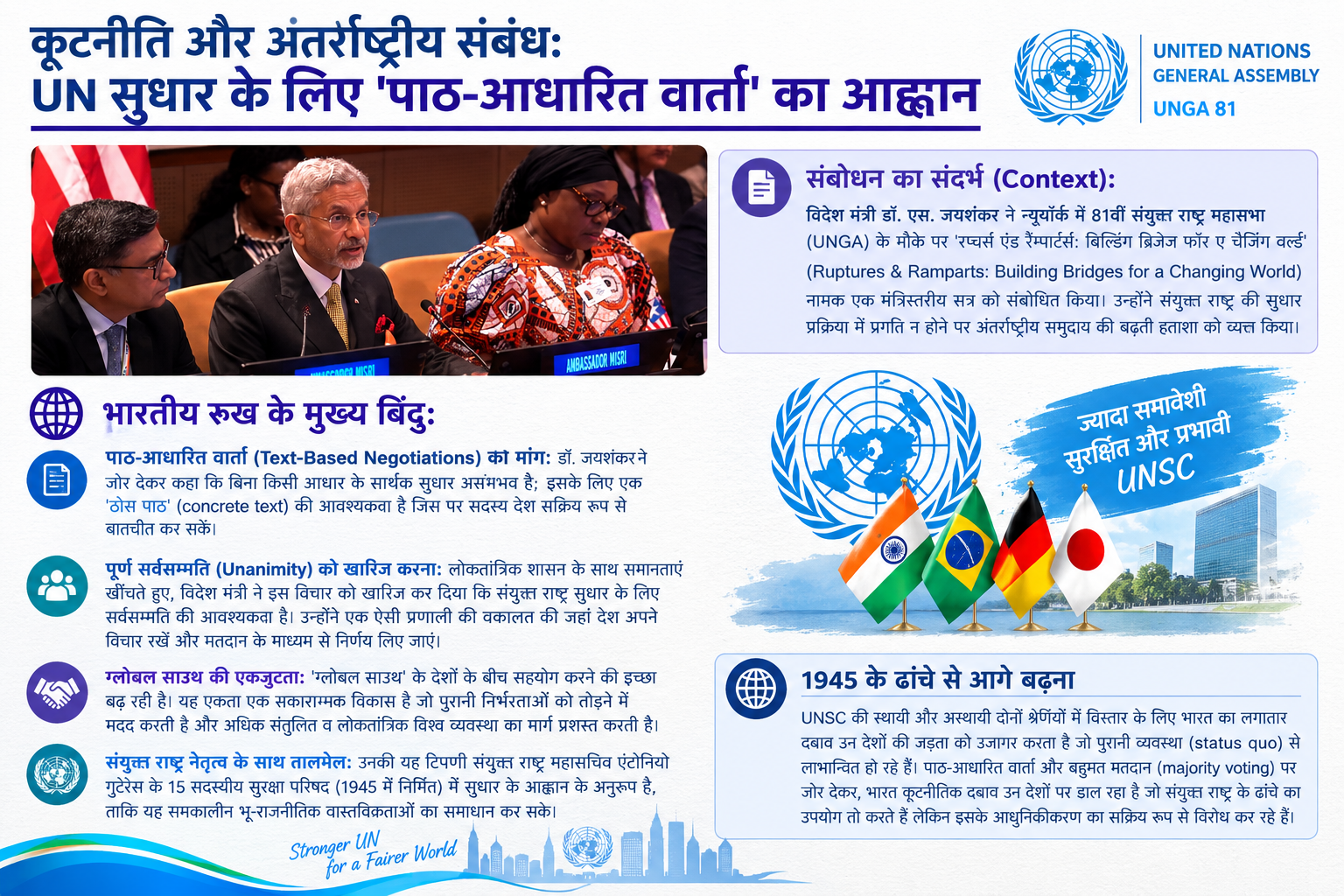
81वीं UNGA में एक मंत्रिस्तरीय सत्र को संबोधित करते हुए, विदेश मंत्री डॉ. एस. जयशंकर ने संयुक्त राष्ट्र सुरक्षा परिषद में सुधार के लिए तत्काल 'पाठ-आधारित वार्ता' का आग्रह किया और स्पष्ट किया कि पूर्ण सर्वसम्मति की मांग इस प्रक्रिया को रोक नहीं सकती।
विदेश मंत्री डॉ. एस. जयशंकर ने न्यूयॉर्क में 81वीं संयुक्त राष्ट्र महासभा (UNGA) के मौके पर 'रप्चर्स एंड रैम्पार्ट्स: बिल्डिंग ब्रिजेज फॉर ए चेंजिंग वर्ल्ड' (Ruptures & Ramparts: Building Bridges for a Changing World) नामक एक मंत्रिस्तरीय सत्र को संबोधित किया। उन्होंने संयुक्त राष्ट्र की सुधार प्रक्रिया में प्रगति न होने पर अंतर्राष्ट्रीय समुदाय की बढ़ती हताशा को व्यक्त किया।
- पाठ-आधारित वार्ता (Text-Based Negotiations) की मांग: डॉ. जयशंकर ने जोर देकर कहा कि बिना किसी आधार के सार्थक सुधार असंभव है; इसके लिए एक 'ठोस पाठ' (concrete text) की आवश्यकता है जिस पर सदस्य देश सक्रिय रूप से बातचीत कर सकें।
- पूर्ण सर्वसम्मति (Unanimity) को खारिज करना: लोकतांत्रिक शासन के साथ समानताएं खींचते हुए, विदेश मंत्री ने इस विचार को खारिज कर दिया कि संयुक्त राष्ट्र सुधार के लिए सर्वसम्मति की आवश्यकता है। उन्होंने एक ऐसी प्रणाली की वकालत की जहां देश अपने विचार रखें और मतदान के माध्यम से निर्णय लिए जाएं।
- ग्लोबल साउथ की एकजुटता: 'ग्लोबल साउथ' के देशों के बीच सहयोग करने की इच्छा बढ़ रही है। यह एकता एक सकारात्मक विकास है जो पुरानी निर्भरताओं को तोड़ने में मदद करती है और अधिक संतुलित व लोकतांत्रिक विश्व व्यवस्था का मार्ग प्रशस्त करती है।
- संयुक्त राष्ट्र नेतृत्व के साथ तालमेल: उनकी यह टिप्पणी संयुक्त राष्ट्र महासचिव एंटोनियो गुटेरेस के 15 सदस्यीय सुरक्षा परिषद (1945 में निर्मित) में सुधार के आह्वान के अनुरूप है, ताकि यह समकालीन भू-राजनीतिक वास्तविकताओं का समाधान कर सके।
UNSC की स्थायी और अस्थायी दोनों श्रेणियों में विस्तार के लिए भारत का लगातार दबाव उन देशों की जड़ता को उजागर करता है जो पुरानी व्यवस्था (status quo) से लाभान्वित हो रहे हैं। पाठ-आधारित वार्ता और बहुमत मतदान (majority voting) पर जोर देकर, भारत कूटनीतिक दबाव उन देशों पर डाल रहा है जो संयुक्त राष्ट्र के ढांचे का उपयोग तो करते हैं लेकिन इसके आधुनिकीकरण का सक्रिय रूप से विरोध कर रहे हैं।
Diplomacy & IR: EAM Jaishankar Calls for Text-Based Negotiations for UN Reform
26 Sep 2026
Addressing a ministerial session at the 81st UNGA, EAM Dr. S. Jaishankar urged for immediate text-based negotiations to reform the UN Security Council, stating that the demand for absolute unanimity should not stall the process.
External Affairs Minister Dr. S. Jaishankar addressed a ministerial session titled ‘Ruptures & Ramparts: Building Bridges for a Changing World’ on the sidelines of the 81st UN General Assembly (UNGA) in New York. He voiced the international community's growing frustration over the stalled reform process of the United Nations.
- Demand for Text-Based Negotiations: Dr. Jaishankar stressed that meaningful reform is impossible in a vacuum; it requires a concrete text that member states can actively negotiate upon.
- Rejecting Absolute Unanimity: Drawing parallels with democratic governance, the EAM rejected the idea that UN reform requires unanimity. He advocated for a system where countries put forward their views and decisions are made through democratic voting to prevent stalling.
- Solidarity of the Global South: There is an increasing willingness among Global South nations to collaborate. This unity is a positive development that helps break old dependencies and paves the way for a more balanced, democratic world order.
- Alignment with UN Leadership: His remarks align with UN Secretary-General Antonio Guterres’s recent calls to reform the 15-member Security Council (created in 1945) so that it holds the legitimacy required to address contemporary geopolitical realities.
India’s consistent push for expansion in both permanent and non-permanent UNSC categories exposes the systemic inertia of nations benefiting from the status quo. By pushing for text-based negotiations and majority voting, India is shifting the diplomatic pressure onto those utilizing the UN's framework while actively resisting its modernization.