शासन और सामाजिक न्याय: पीएम मोदी ने किशोरियों के विकास और महिला सशक्तिकरण पर दिया जोर
10 Oct 2026
'महिला एवं बाल विकास' पर राष्ट्रीय विभागीय शिखर सम्मेलन में पीएम मोदी ने किशोरियों के स्वास्थ्य, जनभागीदारी और 'वोकल फॉर लोकल' (Vocal for Local) तथा ODOP जैसी पहलों के माध्यम से महिला सशक्तिकरण पर जोर दिया।
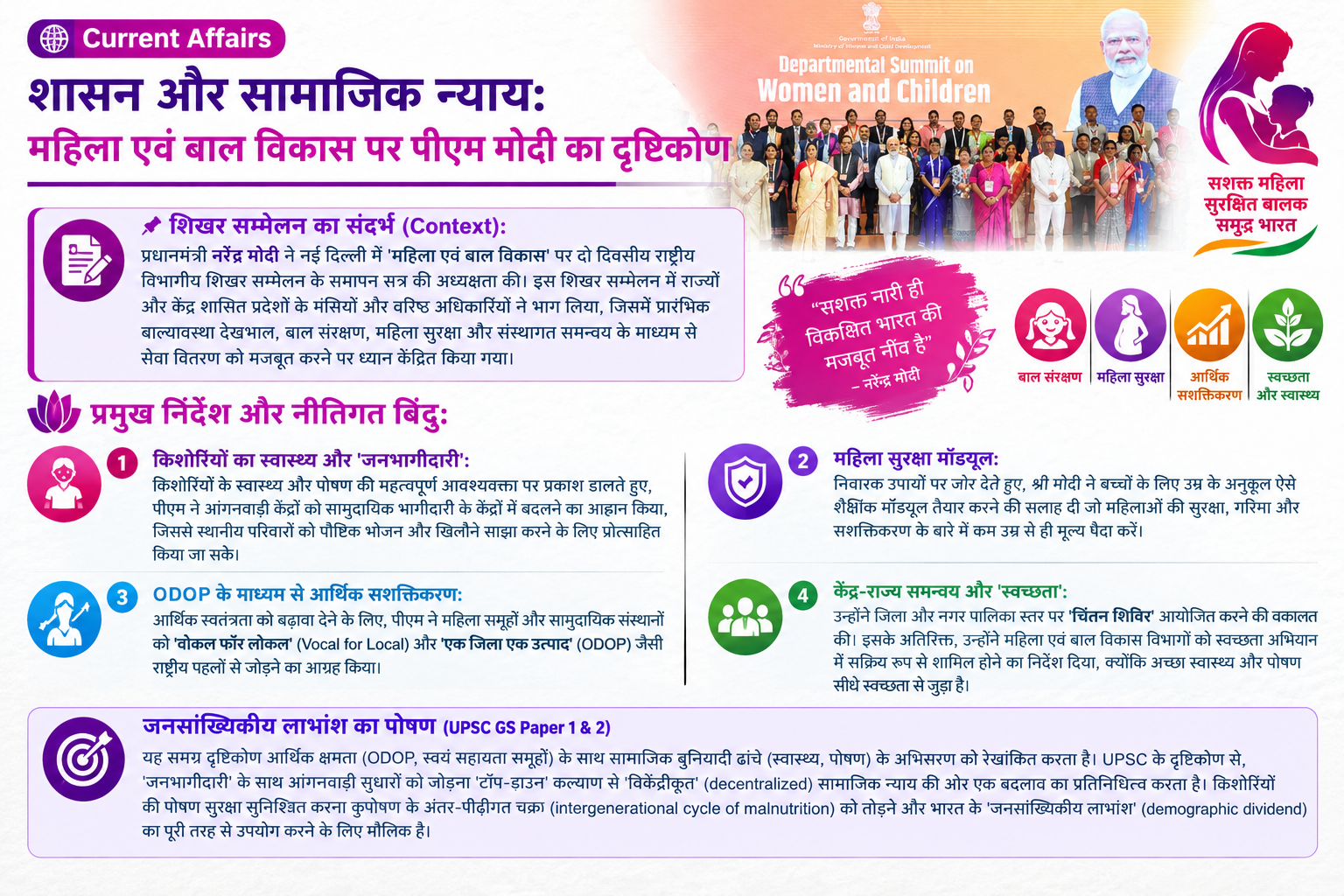
प्रधानमंत्री नरेंद्र मोदी ने नई दिल्ली में 'महिला एवं बाल विकास' पर दो दिवसीय राष्ट्रीय विभागीय शिखर सम्मेलन के समापन सत्र की अध्यक्षता की। इस शिखर सम्मेलन में राज्यों और केंद्र शासित प्रदेशों के मंत्रियों और वरिष्ठ अधिकारियों ने भाग लिया, जिसमें प्रारंभिक बाल्यावस्था देखभाल, बाल संरक्षण, महिला सुरक्षा और संस्थागत समन्वय के माध्यम से सेवा वितरण को मजबूत करने पर ध्यान केंद्रित किया गया।
- किशोरियों का स्वास्थ्य और 'जनभागीदारी': किशोरियों (adolescent girls) के स्वास्थ्य और पोषण की महत्वपूर्ण आवश्यकता पर प्रकाश डालते हुए, पीएम ने आंगनवाड़ी केंद्रों को सामुदायिक भागीदारी (जनभागीदारी) के केंद्रों में बदलने का आह्वान किया, जिससे स्थानीय परिवारों को पौष्टिक भोजन और खिलौने साझा करने के लिए प्रोत्साहित किया जा सके।
- महिला सुरक्षा मॉड्यूल: निवारक उपायों पर जोर देते हुए, श्री मोदी ने बच्चों के लिए उम्र के अनुकूल ऐसे शैक्षिक मॉड्यूल तैयार करने की सलाह दी जो महिलाओं की सुरक्षा, गरिमा और सशक्तिकरण के बारे में कम उम्र से ही मूल्य पैदा करें।
- ODOP के माध्यम से आर्थिक सशक्तिकरण: आर्थिक स्वतंत्रता को बढ़ावा देने के लिए, पीएम ने महिला समूहों और सामुदायिक संस्थानों को 'वोकल फॉर लोकल' (Vocal for Local) और 'एक जिला एक उत्पाद' (ODOP) जैसी राष्ट्रीय पहलों से जोड़ने का आग्रह किया।
- केंद्र-राज्य समन्वय और 'स्वच्छता': उन्होंने जिला और नगर पालिका स्तर पर 'चिंतन शिविर' आयोजित करने की वकालत की। इसके अतिरिक्त, उन्होंने महिला एवं बाल विकास विभागों को स्वच्छता अभियान में सक्रिय रूप से शामिल होने का निर्देश दिया, क्योंकि अच्छा स्वास्थ्य और पोषण सीधे स्वच्छता से जुड़ा है।
यह समग्र दृष्टिकोण आर्थिक क्षमता (ODOP, स्वयं सहायता समूहों) के साथ सामाजिक बुनियादी ढांचे (स्वास्थ्य, पोषण) के अभिसरण को रेखांकित करता है। UPSC के दृष्टिकोण से, 'जनभागीदारी' के साथ आंगनवाड़ी सुधारों को जोड़ना 'टॉप-डाउन' कल्याण से 'विकेंद्रीकृत' (decentralized) सामाजिक न्याय की ओर एक बदलाव का प्रतिनिधित्व करता है। किशोरियों की पोषण सुरक्षा सुनिश्चित करना कुपोषण के अंतर-पीढ़ीगत चक्र (intergenerational cycle of malnutrition) को तोड़ने और भारत के 'जनसांख्यिकीय लाभांश' (demographic dividend) का पूरी तरह से उपयोग करने के लिए मौलिक है।
Governance & Social Justice: PM Modi Champions Development of Adolescent Girls & Women's Empowerment
10 Oct 2026
At the National Departmental Summit on Women and Child Development, PM Modi emphasized adolescent health, community-driven Anganwadis, and the integration of 'Vocal for Local' and ODOP initiatives to drive women's economic empowerment.
Prime Minister Narendra Modi chaired the valedictory session of the two-day National Departmental Summit on Women and Child Development in New Delhi. The summit brought together Ministers and senior officials from States and UTs to deliberate on early childhood care, child protection, women's safety, and strengthening service delivery through institutional convergence.
- Adolescent Health & 'Jan Bhagidari': Highlighting the critical need for adolescent girls' health and nutrition, the PM called for transforming Anganwadi Centres into hubs of community participation (Jan Bhagidari), encouraging local families to contribute nutritious food and educational toys.
- Women’s Safety Modules: Emphasizing preventive measures, Mr. Modi advised the formulation of age-appropriate educational modules for children that instill values regarding women's safety, dignity, and empowerment from an early age.
- Economic Empowerment via ODOP: To bolster economic independence, the PM urged linking women’s collectives and community institutions with national initiatives like 'Vocal for Local' and 'One District One Product' (ODOP), further suggesting that universities undertake social impact studies of these integrations.
- Centre-State Synergy & Swachhata: He advocated for decentralized brainstorming via Chintan Shivirs at the district and municipal levels. Additionally, he mandated that WCD Departments take active ownership of the Swachhata Abhiyan, intertwining sanitation intimately with health and nutritional outcomes.
This holistic approach underscores the convergence of social infrastructure (health, nutrition) with economic capability (ODOP, self-help groups). For UPSC aspirants, linking Anganwadi reforms with Jan Bhagidari represents a shift from top-down welfare to decentralized, community-owned social justice. Ensuring the nutritional security of adolescent girls is foundational to breaking the intergenerational cycle of malnutrition and fully realizing India's demographic dividend.